
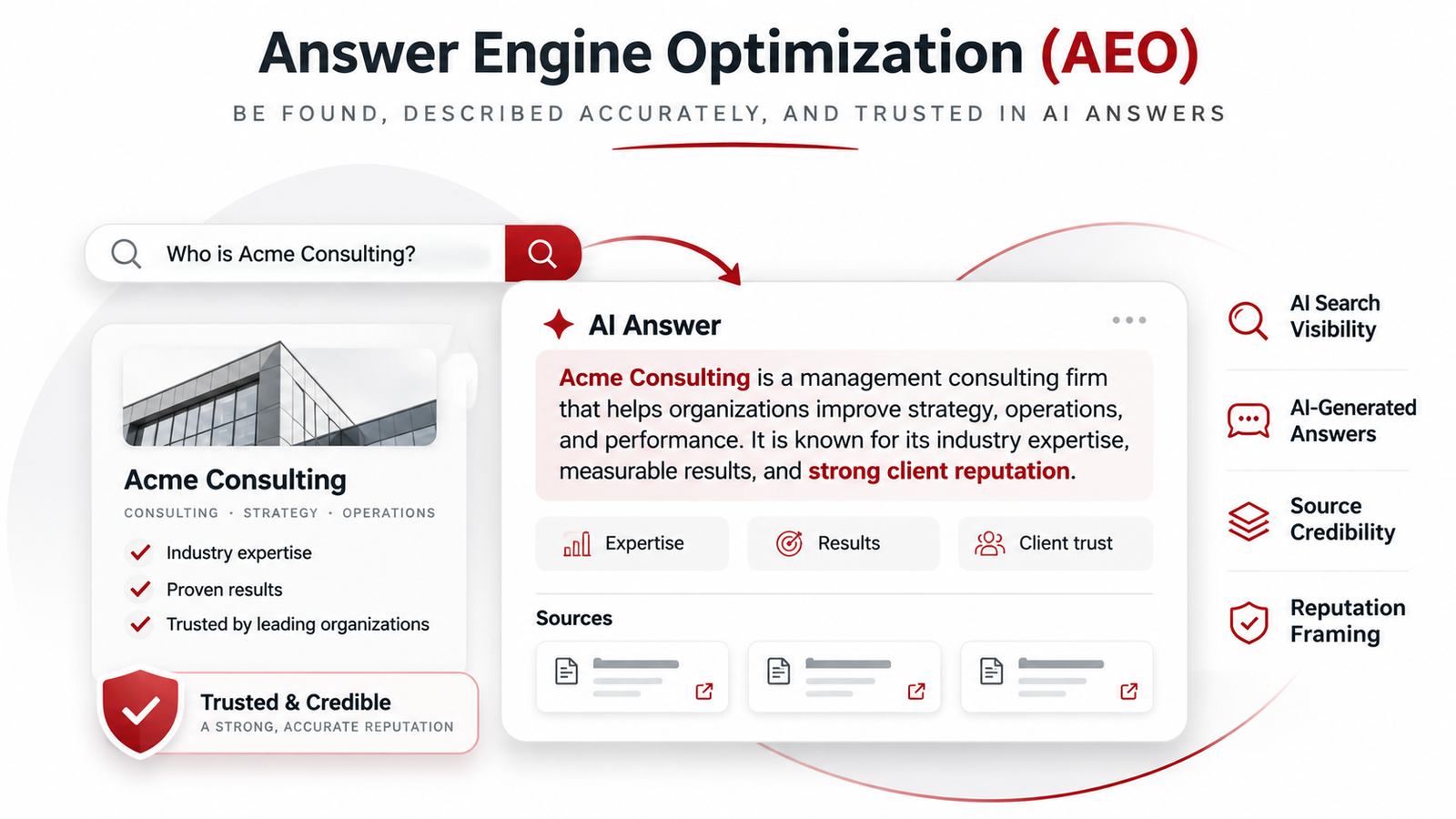
Suppose a potential client asks an AI assistant about your company. The answer correctly explains what you do, then spends most of its space on a dispute from several years ago. It never mentions how that dispute was resolved.
Your company appeared in the answer. But would you call that a good result?
An executive or business owner could face a similar problem: an otherwise accurate profile that leaves out a current role or gives an old controversy more attention than their recent work. For someone encountering that name for the first time, the omissions matter.
Answer Engine Optimization addresses how information appears in these answers. From a reputation management perspective, the work includes looking closely at the description a reader receives and the evidence behind it.
What AEO means
Answer Engine Optimization, or AEO, is the practice of improving the visibility and usefulness of information in systems that answer people’s questions. In AI search, that includes making relevant content easier to discover and use in a generated response. Google describes AEO as a term for work focused on visibility in AI search experiences.
For a business, this could involve explaining its services clearly enough to answer a prospective customer’s question. For an individual, it might involve making their professional background easier to establish, particularly if they share a name with someone else.
Reputation work adds another concern. An answer can mention the right company, use a legitimate source and still leave the reader with an incomplete impression. That deserves investigation even when the company appears prominently.
How AEO fits with SEO
AEO builds on much of the work involved in search engine optimization. Google’s guidance says established SEO practices remain relevant to its AI search features, and special AI markup is not required. Clear content and a website that search systems can access remain useful foundations. Google Search Central
The additional task is to examine the answer itself. A search ranking can tell you where a biography appears. It cannot tell you whether an AI summary identifies the person’s current employer correctly.
Start with the questions people would actually ask
Before commissioning new articles or rewriting your website, look at what someone researching you would encounter.
Begin with ordinary questions:
- What does [company name] do?
- What is [person’s name] known for?
- What should I know before working with [company or person]?
Add questions specific to your services, professional background or known concerns. Keep the wording realistic. If every question assumes wrongdoing, the exercise will tell you more about responses to accusations than about a typical introduction to your business.
Save the full response, the exact question, the date and the platform. Record the cited links and whether web search was used. These details make it possible to revisit an answer and investigate where a problem originated.
Read the answers as a prospective client would. Check basic identity information first, including the person’s role and the organization involved. Then look at the claims that could influence a decision. Does the answer explain what a complaint concerned? Does it distinguish an allegation from a finding? Is a development described as current when it happened years ago?
Keep the source links with your notes so you can check the reporting and any later updates.
Read the pages behind the answer
AI search can bring together information from several webpages. Google explains that its AI features may run related searches to develop a response and identify supporting material. That makes the pages behind a summary an important part of the review. Google’s explanation of AI search features
Return to the hypothetical dispute in the opening. The first thing we would check is whether the cited article was published before the resolution. If it was, the original reporting may be accurate for its date. The incomplete picture may come from the answer failing to include what happened afterward.
Next, look for the update. Is there a public record of the outcome? Does it clearly identify the same company and the same dispute? Is the relevant explanation accessible, or buried in a document that is difficult to locate?
Read the source carefully, too. A reporter describing what someone alleged is different from a reporter establishing that it happened. Check whether the AI summary preserves that distinction.
Make your own information easier to verify
Your website is a sensible place to begin because you can address its gaps directly.
A service page should explain what the company actually provides. A biography should make the person’s current role and relevant experience easy to establish. If an executive has changed positions, give the old role an end date where appropriate. Leaving both positions in the present tense creates unnecessary ambiguity for anyone researching them.
Specific details also give a reader something to assess. “An accomplished industry leader” says little on its own. Explaining the person’s responsibilities, naming relevant qualifications and linking to work they have done gives the description substance.
Google’s content guidance encourages clear sourcing, evidence of expertise and original value. Those are useful standards for deciding whether a page answers the reader’s question. Google’s helpful content guidance
Have your website team check access as well. Important pages should be reachable through the site’s navigation, and any restrictions on search crawlers should be intentional. Google’s recommendations include allowing crawling and making important information available as text. Google Search Central
This work does not always require a large publishing project. A clear update to an existing biography or service page may address the information gap you found.
When the problem needs more than new content
A damaging answer needs a careful diagnosis. If an underlying article contains an error, a correction request should identify the exact statement and provide evidence. If the article is accurate but the AI summary misrepresents it, document that discrepancy and use the platform’s available feedback process.
Criticism of a real, unresolved problem calls for action, not a more flattering biography.
Digital Crisis PR becomes relevant when the response itself could affect the situation. Before publishing a statement, consider who needs the information, what can be substantiated and whether the statement will clarify the issue. An unnecessary response can also draw attention to a claim that had little visibility.
The same care applies when seeking coverage. A useful story gives a journalist something verifiable to report, such as a substantive business development or completed project. Repeating a promotional announcement across several websites does not create several independent confirmations of its claims.
How to tell whether the work is helping
Revisit the questions from your initial review and compare the answers over time. Track whether the specific problems you identified persist. If an AI answer named the wrong employer, has that changed? If an answer omitted a documented resolution, does it now include it, and does the cited source support the wording?
Record mixed results. One favorable answer is a reason to keep checking; it is not evidence that the issue has disappeared across every platform.
Expect some variation. Google says its AI features can produce different responses and supporting links, and it does not guarantee that eligible content will be crawled, indexed or shown. Google Search Central
For reputation work, a useful review should explain what has improved, what remains unresolved and which actions are supported by the evidence. That gives you a basis for deciding where to spend time next.
At Reputation Control Inc., we approach Answer Engine Optimization as part of online reputation management and Digital Crisis PR. We look at how companies and individuals are described and what information is shaping those descriptions.
If you are concerned about what AI answers say about your business or your name, contact Reputation Control Inc. for a confidential consultation.